
Why Consultants With Proven Expertise Still Struggle to Get Clients

You've done the work. You've delivered results. Clients have told you, sometimes in exact words, that you changed their business or their life. And yet:
- You sit down to write a LinkedIn post and nothing comes out. You know more than enough to fill a page, but every sentence tries to be comprehensive and ends up saying nothing.
- Someone asks what you do and you freeze. You reach for language that covers everything. It lands on nothing. The conversation moves on and you're still standing there thinking about what you should have said.
- You get on a call with a prospect and find yourself explaining too much, too fast. You're walking them through your methodology, your credentials, your range of services. By the time you finish, they're evaluating a presentation instead of solving a problem.
- You send a carefully crafted offer to ten people. Nobody responds. One person is offended. You thought the offer showcased your best thinking. The market didn't recognize it.
The expertise is real. The results are real. But the people who need you most can't find you, and when they do, the conversation doesn't go anywhere.
I've been in the room for every one of these moments, and the through-line is the same: what you know about yourself and what comes out in the moment don't match. Experienced professionals are freezing through introductions, over-explaining on sales calls, walking away from conversations replaying what went wrong — when they should have been celebrating what went right. These experts don't need more marketing tactics. Their best work has just never been organized in a way where it can speak for itself. That's the problem we solve inside this community, and the rest of this post explains how.
It starts with how you describe your work — and what's missing from that description.
You're Describing Half Your Work
Here's what's actually happening. You know what you do. You built it, deliver it, spent your time and energy trying to do it better. That part of the description comes easily because it's your direct experience.
But that's only half the story. The other half is what the client received, what they felt, what changed in their world. That half requires you to step outside your own experience and see the work through someone else's eyes. Most consultants have never completed that second half with any precision. So when it's time to describe the work to someone new, they describe their side: what they know, what they do, how they do it. And the prospect hears capability. Not a solution to their problem.
This incomplete description is where everything downstream breaks. Your content doesn't land because you're writing about your expertise instead of their experience. Your conversations don't convert because you're explaining your process instead of describing their situation. Your offers don't get responses because they showcase what excites you instead of what the prospect can recognize as their problem.
The real issue underneath all of it: you haven't been honest enough with yourself about what your best work actually is, how you do it, and who you do it for.
When that clarity is missing, everything downstream inherits the vagueness. Your avatar is abstract. Your content speaks to no one specific. Your conversations are uphill. Your pipeline feels random. You compensate by working harder at each piece independently. More posts. More networking. More follow-up. More explaining. But more of a disconnected thing doesn't compound. It just exhausts you.
When that clarity is present, everything changes. You know exactly who you're talking to. Your content resonates because it describes what they're living through. Your conversations convert because the right person showed up already understanding what you do. The compounding kicks in because you've been saying the same thing to the same person for weeks and months and years. People come to you because they're certain what you do and who you do it for.
The Five Patterns That Keep You Stuck
When consultants attempt client acquisition without the right conditions, five specific things break down. These are the patterns that show up when the foundational clarity isn't there yet.
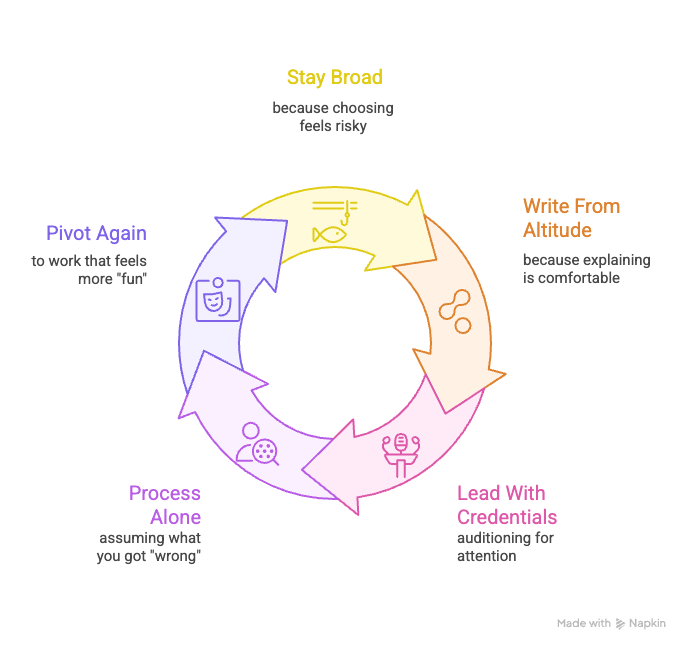
- You stay broad because choosing feels risky. Narrowing your description feels like shrinking your opportunity, so you keep the language open and the positioning wide. Every conversation tries to cover everything. Nothing compounds because nothing repeats. Read more about what happens when you try to speak to everyone at once →
- You write from your expertise instead of their experience. You see the whole landscape of what you know, every connection, every layer. But the person you're trying to reach lives at ground level. They have a meeting in an hour. They have a problem on their desk. When you write from 30,000 feet, they can't find themselves in what you're saying. Read more about what happens when expertise gets in the way of content →
- You lead with credentials instead of curiosity. You've worked hard to build your confidence and your expertise, and that preparation shows up as a presentation the prospect has to grade. The conversation feels like an audition instead of a diagnostic. The prospect stays polite and never comes back. Read more about what happens when confidence works against you →
- You interpret every response personally because nobody helps you process it. A prospect pauses and you think you said something wrong. An offer gets no response and you question everything. Your personal brand is on the line every time you put yourself out there, and without anyone to help you make sense of what happened, every data point becomes emotional.
- You design offers around what excites you instead of what the market can recognize. The cutting-edge work feels more worthy of selling than the proven work that would actually get you in the door. So you lead with what impresses you and the market doesn't respond because they can't see themselves in it. Read more about what happens when nobody responds to your offer →
These five patterns show up in combination, and they feed each other. Breadth creates altitude problems because you can't write specifically when you haven't chosen who you're writing to. Altitude creates performance problems because when your content doesn't attract the right people, every conversation carries more weight. Performance creates isolation because the conversations feel personal and there's no one to help you see what actually happened. And ego keeps the whole cycle running because you'd rather design the offer that excites you than start with the proven work that would build the foundation.
Start With Your Best Work, Not Your Best Idea
The instinct is to start with the question "who is my ideal client?" and build outward from there.
That's like a young woman describing her prince charming. Tall, kind, successful, good with kids. It sounds right. It feels true. But put ten men who match that description in front of her and she might not feel anything. Because the description came from imagination, not experience. Now ask her about the best date she's ever been on. She remembers the restaurant, the conversation, what made her laugh, why she didn't want the evening to end. That memory gives her something the prince charming list never could: she knows what she's looking for when she feels it.
The ideal client exercise is the prince charming list. It produces demographics, aspirations, profiles that sound reasonable on paper and help with nothing specific.
The better question is: what work am I most proud of?
When you ask someone who they serve, you get a polished answer about who they'd like to serve. When you ask someone what past client work they're most proud of, something different happens. They're not guessing anymore. They're running instant replay. They remember the room, the problem, the moment it shifted. They speak with more specificity, more groundedness, more presence because they have command of the details. They lived them.
That command shows up in everything downstream. Your content has texture because you're describing something real. Your conversations have authority because you're speaking from experience. Your confidence is earned because the proof is yours. None of that is available when you're assembling an ideal client from fragments of hope.
Start there. One engagement. One person. One result. Not the engagement that sounds most impressive. The one where you know exactly what you did, what happened, and what changed.
From that honest examination, the WHO reveals itself. You don't pick your ideal client from a menu. You discover them inside the work you've already done. The person who hired you. The situation they were in when they reached out. What they valued most about the engagement. Why that particular relationship produced results you're proud of. When you examine the work honestly, patterns emerge that you couldn't see when you were inventing positioning from ambition.
Client Story

Nicole Girouard — Communications Consultant
The best work comes first because it's honest. The WHO comes second because the WHO lives inside the WHAT. And from there, everything else in client acquisition has a source to draw from.
What It Looks Like When the Pieces Connect
Once the best work is named honestly and the WHO becomes specific, three things change. They don't change in theory. They change in how your week feels.
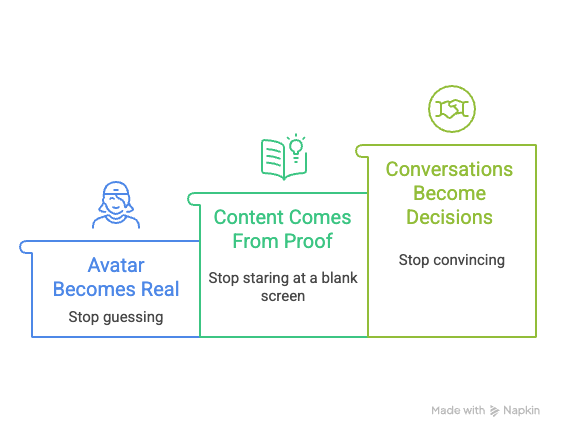
Your Avatar Becomes Someone You Recognize
The avatar isn't a profile. It's a person you know. You know what keeps them up at night. You know what's on their desk Tuesday morning. You know how they describe their own situation, because you've been in the room while they described it.
When the avatar is real, you stop guessing what to say and start describing what you've seen. Your content stops trying to be interesting and starts being useful. Your conversations stop requiring explanation because the person across from you recognizes themselves in the first two sentences.
Client Story

Fran Frye — Executive Coach
Your Content Comes From Proof, Not Pressure
When the avatar is specific and the best work is documented, content stops being something you manufacture and starts being something you share. You're not staring at a blank screen trying to be comprehensive. You're describing a situation your client lived through and connecting it to what you know.
The posts get simpler. Seventy-five words about one felt experience your prospect is having. Not a thought leadership piece. Not a comprehensive guide. A description of something real that happened, shared through the lens of someone who was in the room. That's a post. Do it consistently and the pipeline responds.
The deeper truth about marketing platforms: LinkedIn, YouTube, Instagram, email, they all reward the same fundamental. Content that resonates with a human being. That has been true for every medium in the history of media. When your content describes what your prospect is living through instead of what you're good at, every platform works in your favor.
It doesn't mean this is push-button easy. There are things that will try to knock this off course. The blank screen stares back at you because you're trying to capture your entire expertise in one post. [Read more →] You did great work and now the content calendar is empty because you didn't extract the value from it. [Read more →] You wrote a message that made perfect sense to you and nobody understood it. [Read more →] Each of these moments has a specific cause and a specific fix, and the fix is almost always the same: go back to the proof. Go back to the WHO. Say what you know about what they're living through.
Your Conversations Become Decisions
When the avatar is clear and the content has done its job, the prospect arrives already understanding what you do. The conversation is fundamentally different from what most consultants experience.
You're not educating. You're not explaining your methodology. You're not performing. You're asking: where are you today? Where do you want to be? What's the size of the gap? If the gap is large, it's obvious they should fix it. If it's small, it's obvious they shouldn't. Two adults going back and forth, surfacing context, arriving at a decision.
You shape the conversation from the beginning. "We have about 35 minutes. I want to cover where you are, where you want to be, and what might be in between." That's not pushy. That's respect for both people's time. And serious prospects, the ones with real problems, want that. They've been through enough unstructured conversations with vendors who don't know why they're in the room. They don't mind a sales process. They mind a bad one.
Client Story

Joan Lawrence-Ross — Leadership Coach
By the end of a well-run conversation, the prospect makes a decision. The consultant listens for which direction they're moving and helps them land it clearly. Regardless of the outcome, both people leave knowing exactly what happens next. That efficiency and mutual respect is rare. Prospects remember it. And the information surfaced during the conversation, what problems exist, how they're described, what the prospect values, sharpens every box it touches.
Why You Can't Build This Alone
Client acquisition is heavy in two directions at once.
First, most consultants were never taught how to do this. Not the whole thing. You may have had sales experience, maybe retail in college, maybe a role inside a larger team. But that experience covered your piece of the process, not the design of it. Nobody asked you to decide who to pursue, what to say to attract them, how to structure the conversation, and how to make every piece feed the next. The gaps are natural. You were never asked to think through the entire sequence.
Second, your personal brand is tied to the business. Every marketing piece, every webinar, every call is you. Your name, your face, your voice. When a prospect says no, it feels personal. When a piece of content doesn't land, it feels like rejection. The five dangers from earlier aren't theoretical. They show up every time you put yourself in front of the market.
You need people who can empathize because they've been through the same thing. People who can listen when you need to get the weight off and give you new energy when yours is spent. People who can help you interpret what happened in a conversation you were too close to see clearly.
When you're on a problem call and the prospect pauses in a way you didn't expect, or says something enthusiastic and then goes quiet, that's data you received in real time. You may not be able to make sense of it alone because you were inside the experience. In a community of peers, you can say: when this happened, I felt this way. Has anyone felt that? And now other people are helping you see what you couldn't see because you were the one living through it.
Your clients hire you because they can't see what you see. This is the same dynamic, pointed at your business instead of theirs.
How Client Acquisition Connects to Everything Else
Client acquisition doesn't exist in isolation. It's the second movement in a larger system.
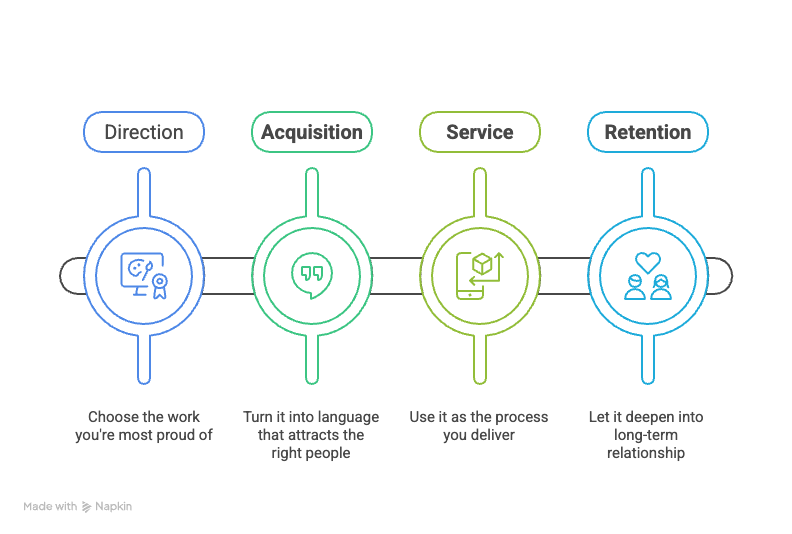
Before you can acquire clients, you need to know what work you want to repeat. That's a choice that requires sitting with yourself honestly enough to name what you're best at, what you care about most, and what kind of business you actually want to run. [Explore how direction-setting works →]
After you acquire clients, you need to deliver on what you promised. The same case study that powered your marketing becomes the process you follow in onboarding, delivery, and proof capture. What was language in acquisition becomes process in delivery. [Explore how client service works →]
And after you deliver, the relationship either deepens or ends. The clients who stay become the proof that powers everything going forward. What was process in service becomes relationship in retention. [Explore how client retention works →]
The case study is the thread that connects all four. It starts as a choice. It becomes language. It becomes process. It becomes relationship. When client acquisition feels hard, it's almost always because the case study hasn't been surfaced clearly enough for the downstream pieces to do their jobs.
Frequently Asked Questions
What if I have multiple types of clients and can't pick just one?
You're not picking a client type. You're picking a starting point. The case study exercise asks which work you're most proud of, not which work is the only work you'll ever do. You're choosing a front door, not building a wall.
What if I don't have a dramatic transformation story?
You don't need one. You need a real one. If you helped someone do something they couldn't do before you arrived, you have a case study. The consultants whose stories resonate most aren't the ones with the biggest numbers. They're the ones whose clients experienced a specific shift.
What if my best work feels too boring to lead with?
The proven work isn't the ceiling. It's the entry point. It opens the relationship. The exciting, advanced work deepens it. Both get to exist, but in the right order. You don't get to do the interesting stuff if you never get started.
What if my expertise comes from life experience, not client work?
The method works the same way. Isolate a specific experience where you helped someone solve a specific problem. What matters is that you can point to the problem, the process, and the result. Life experience is valid proof, but it still has to be separated, examined, and grounded in specifics.
I know I should be having more sales conversations but I keep finding reasons not to.
That's not a discipline problem. It's a structure problem. When you don't have a clear format for the conversation, every call feels like improvisation with your reputation on the line. Of course you avoid it. The fix isn't forcing yourself onto more calls. It's knowing what the conversation is designed to do before you pick up the phone.
Find Your Best Work.
You've done the work. You've gotten the results. You just haven't had a way to organize what you know so it's ready when the moment arrives.
Let's fix that together. It starts with one conversation.

Alzay Calhoun
Alzay Calhoun believes that consultants don't need more tactics — they need a place to think. For 13+ years, he's helped experts earning $100K–$500K find their best work and build systems around it. "The frameworks behind Coveted Consultant were built from real client work. They're documented across 505 YouTube videos, 25+ case studies, and an ongoing coaching practice.